CLARIN & DARIAH Latvia's Spring Conference 2026: Digital Infrastructure for the Humanities
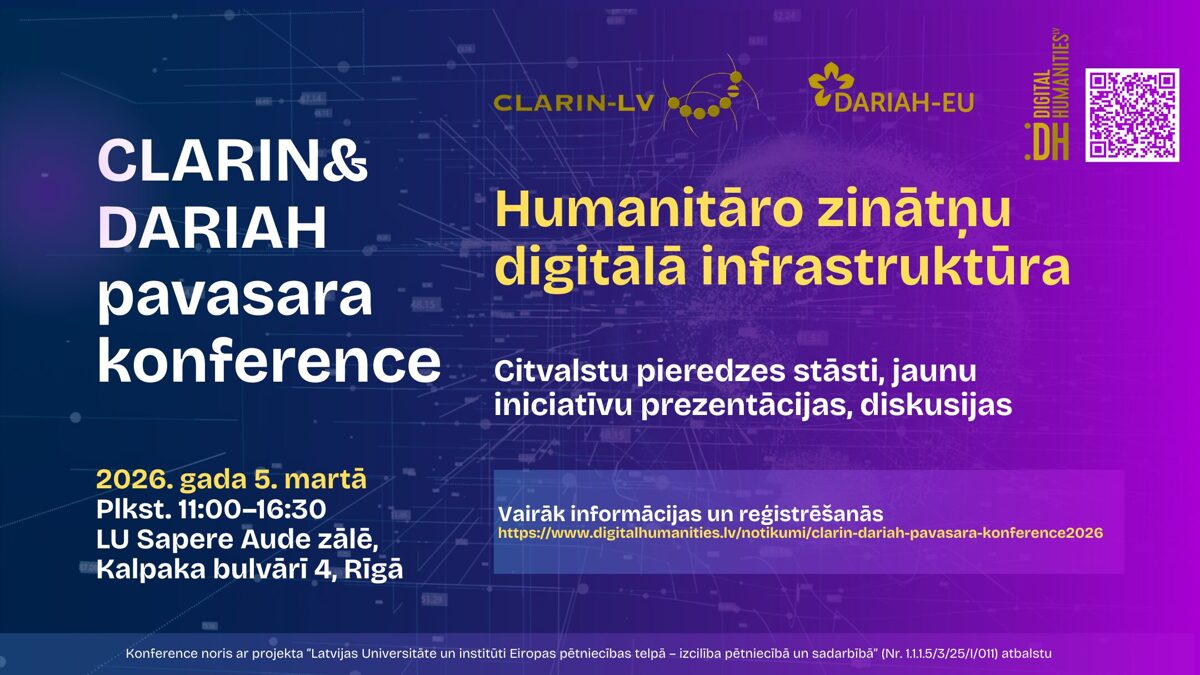
On 5 March 2026, the CLARIN & DARIAH Spring Conference will take place at UL Sapere Aude Hall (Kalpaka Boulevard 4), bringing together researchers, language technology experts, and everyone interested in digital humanities. This conference is a strategically important event that connects national consortia of two leading international research infrastructures in the humanities – CLARIN ERIC and DARIAH-EU – to promote collaboration, knowledge exchange, and the development of digital solutions in the fields of the humanities and social sciences.
The conference program includes experience stories about the operation of the DARIAH and CLARIN infrastructures in Latvia and Europe, highlighting their practical significance in research and interdisciplinary cooperation. Participants will have the opportunity to learn about specific projects, examples, and solutions; digital tools, as well as the use of data and digital resources in the humanities and social sciences, will be demonstrated. The conference will conclude with a discussion addressing the importance of digital infrastructures for the development of the humanities, the challenges involved in building them, and the needs of researchers.
This year marks 10 years since Latvia joined CLARIN ERIC, making a sustained contribution to improving access to language resources, developing digital tools, and fostering international integration in the research environment. Inguna Skadiņa, Head of CLARIN-LV, Professor at the University of Latvia, and Leading Researcher at the Institute of Mathematics and Computer Science, notes:
“Latvian language and cultural life in the digital environment are important to each and every one of us. Digital infrastructures make it possible to preserve research results in the long term and promote the availability of language and cultural data for research, education, and all interested users.”
Meanwhile, Latvia is still on its way toward joining DARIAH-EU – Digital Research Infrastructure for the Arts and Humanities. Emphasizing the need for Latvia to obtain full DARIAH-EU membership status, Sanita Reinsone, Associate Professor at the Faculty of Humanities of the University of Latvia, says:
“Over the past few years, our digital humanities community has drawn closer to DARIAH-EU, and we would like to thank the Ministry of Education and Science for supporting our efforts in strengthening this cooperation. This experience has highlighted how important national consortia and collaboration are for the development of digital humanities. The spring conference, which will become an annual event, provides an excellent platform to meet, learn about the latest developments in digital humanities in Latvia, and discover what our colleagues are working on.”
Registration for the conference is open until March 3:
https://www.digitalhumanities.lv/notikumi/clarin-dariah-pavasara-konference2026
–
The conference is organized by the Institute of Mathematics and Computer Science of the University of Latvia, the Faculty of Humanities of the University of Latvia, and the Institute of Literature, Folklore and Art of the University of Latvia, with support from the project “University of Latvia and Institutes in the European Research Area – Excellence, Activity, Mobility, Capacity” (No. 1.1.1.5/3/25/I/011).