  • LV
  • ENG
DIGITAL HUMANITIES IN LATVIA
  • home
  • events
    • Baltic DH Forum
      • Programme
      • Practical info
  • resource library
  • Workshop series
  • videos
  • BSSDH
    • 2025
      • About
      • Programme
      • Lectures and Workshops
      • Venue
      • Registration
      • Gallery
    • 2024
      • About
      • Programme
      • Lectures and Workshops
      • Venue
      • Registration
      • Gallery
    • 2023
      • About
      • Programme
      • Lectures and Workshops
      • Venue
      • Registration
      • Gallery
    • 2022
      • About
      • Programme
      • Lectures and Workshops
      • Venue
      • Registration
      • Gallery
    • 2019
      • About
      • Programme
      • Lectures and Workshops
      • Venue
      • Registration
      • Gallery
    • 2018
      • Programme
      • Lectures and Workshops
      • How to apply
      • Venue
      • Gallery
  • Projects
    • digiLATE
    • Language Technology Initiative
    • VPP LATE
    • DHELI
    • DH VPP
    • Going beyond search (NordPlus)
  • ERICs
  • about us

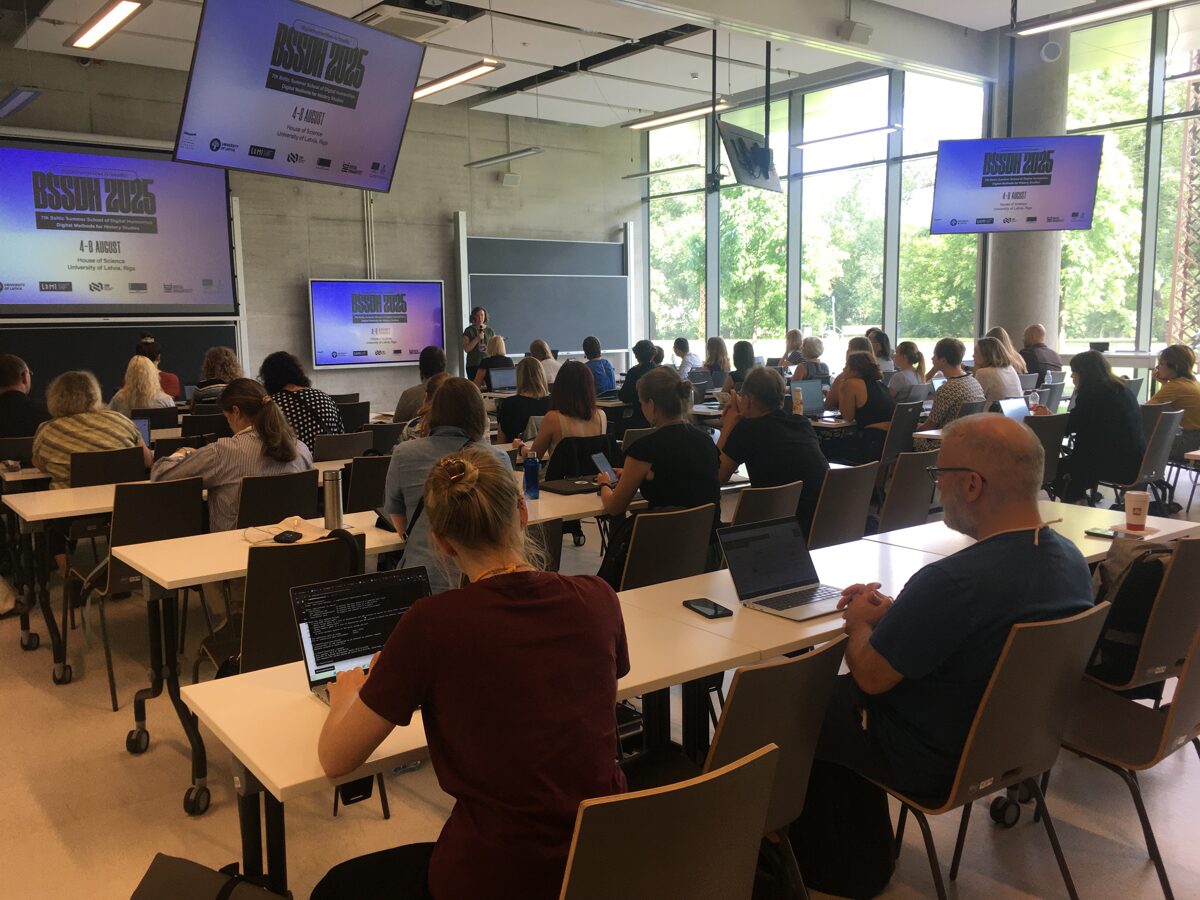
The 7th Baltic Summer School of Digital Humanities has concluded
12 Aug, 2025

Hor01_BSSDH2025_Atklashana_IMG_9022_2-1.JPG

From 4 to 8 August, the 7th Baltic Summer School of Digital Humanities, “Digital Methods for Historical Research”, took place at the University of Latvia’s House of Science. The participants were more than 50 historians, students, and memory institution specialists – mainly from the Baltic states, as well as from Poland, Croatia, Sweden, the United Kingdom, France, Germany, Belgium, and Greece. This summer school offers an opportunity to explore developments in the digital humanities, acquire technical skills, and gain an extensive set of resources and new contacts for future projects.

This year, under the guidance of experienced European researchers in the digital humanities, participants explored current debates and solutions related to AI-based approaches for handwritten text transcription, the use of computational methods to interpret missing historical data, the application of large language models in the humanities, as well as network analysis and the digital mapping of historical materials. The annually increasing number of participants – especially from Latvia – demonstrates that the field of digital humanities continues to grow in relevance, not only among emerging researchers but also among experienced scholars who actively seek to acquire new, practical skills for applying digital methods in humanities research.

Read more »

Recent Posts

  • CLARIN & DARIAH Latvia's Spring Conference 2026: Digital Infrastructure for the Humanities
    10 Feb, 2026
  • Save the date for Baltic Summer School of Digital Humanities 2026
    8 Jan, 2026
  • A seminar will take place titled “Quantitative Approaches to Historical Visual Culture – an Example of Soviet Newsreels”
    30 Oct, 2025
  • The 7th Baltic Summer School of Digital Humanities has concluded
    12 Aug, 2025
  • 7th Baltic Summer School of Digital Humanities to Take Place in Riga
    28 Jul, 2025
  • 6-7 May Jan Hajič, PhD, will give lectures and workshops on Digital Musicology and Computer Analysis of Gregorian Chants in Riga
    16 Apr, 2025
  • Call for applications for the 7th Baltic Summer School of Digital Humanities
    4 Mar, 2025

Archive

  • 2026
    • February
    • January
  • 2025
    • October
    • August
    • July
    • April
    • March
  • 2024
    • November
    • July
    • June
    • May
    • April
  • 2023
    • December
    • November
    • August
    • July
    • June
    • May
    • April
    • February
  • 2022
    • October
    • September
    • July
    • June
    • April
    • March
    • February
    • January
  • 2021
    • October
    • May
    • April
    • March
    • February
  • 2020
    • December
    • March
    • February
    • January
  • 2019
    • October
    • September
    • April
  • 2018
    • October
    • July
    • June
    • May
    • March
    • January
  • 2017
    • October
    • September
digitalhumanities.lv 
supported by the project “University of Latvia and Institutes in the European Research Area – Excellence, Activity, Mobility, Capacity” (No. 1.1.1.5/3/25/I/011).